Safeguarding Rights in Synthetic Media in EA: Ethical AI, Personal Data, and Creative Ownership
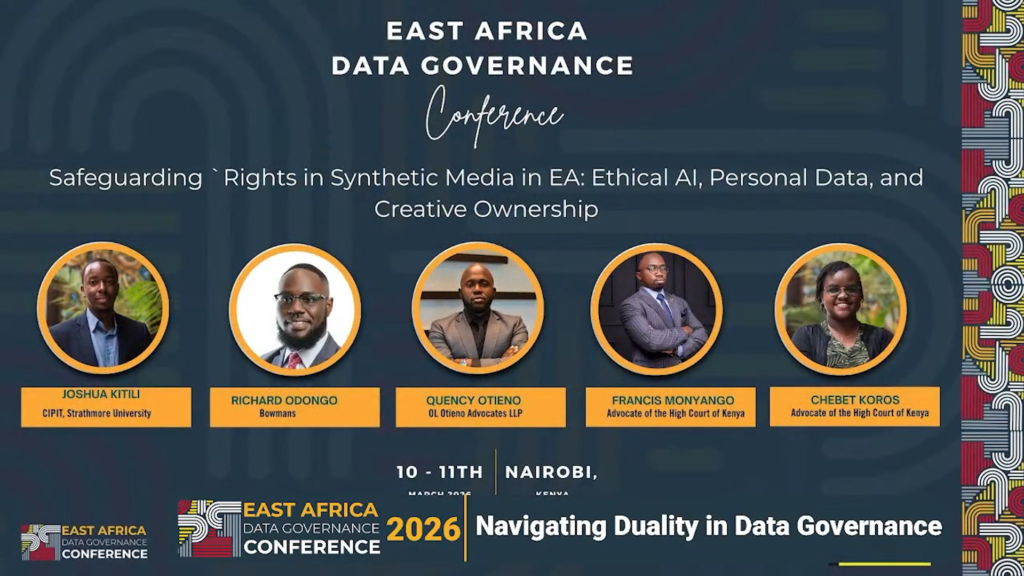
At #EADataGov26, a panel moderated by CIPIT’s Joshua Kitili explored the intersection of AI and intellectual property in the age of synthetic media. As generative AI becomes more embedded in digital ecosystems, questions of consent, transparency, and lawful use of datasets are becoming increasingly urgent; particularly in culturally diverse societies where legal frameworks, enforcement capacity, and information governance structures may struggle to keep pace with emerging technologies. The discussion unpacked key issues shaping the region’s AI governance landscape:
- Francis M., addressed the issue of personal data use in AI systems, referencing the Kenya Data Protection Act. He noted that Section 28 requires personal data to be collected directly from the data subject, while Section 2 provides exceptions where data may be collected indirectly. In the context of AI, this raises questions about data scraping and the reuse of online data to train generative models, including cases where individuals upload their images to AI platforms to generate caricatures.
- Quency Otieno discussed how generative AI systems are trained through machine learning and reinforcement learning, often using large volumes of online data. While this improves model performance, it also raises concerns about bias, misinformation, and the growing sophistication of synthetic media such as deepfakes, which are increasingly difficult to distinguish from authentic content.
- Chebet Koros examined the intersection of AI and copyright law, noting that copyright protection is automatic upon creation once a literary, artistic, or other original work is fixed in tangible form. While registration through the Kenya Copyright Board is recommended, ownership exists without it. She also referenced the Berne Convention, which requires member states to protect copyright across borders, and raised questions around moral rights, attribution, and authorship in AI-generated works.
- Richard Odongo spoke on authorship and ownership in the age of generative AI, noting emerging questions around the level of human input required to claim copyright in AI-generated works. This includes whether a prompt alone can constitute sufficient creative contribution. The discussion also raised broader concerns about how to distinguish human creativity from machine-generated output, and how existing copyright frameworks should respond to these evolving forms of creation.
A huge thank you to our hosts and organizers, @OpenInstituteAfrica and @amnestyinternationalkenya6085
Event Video
Event Details
- Type: Conference
- Mode: Physical Event
- Start: March 10, 2026
- End: March 10, 2026
- Location: Nairobi
- Organizer: Amnesty International Kenya & The Open Institute