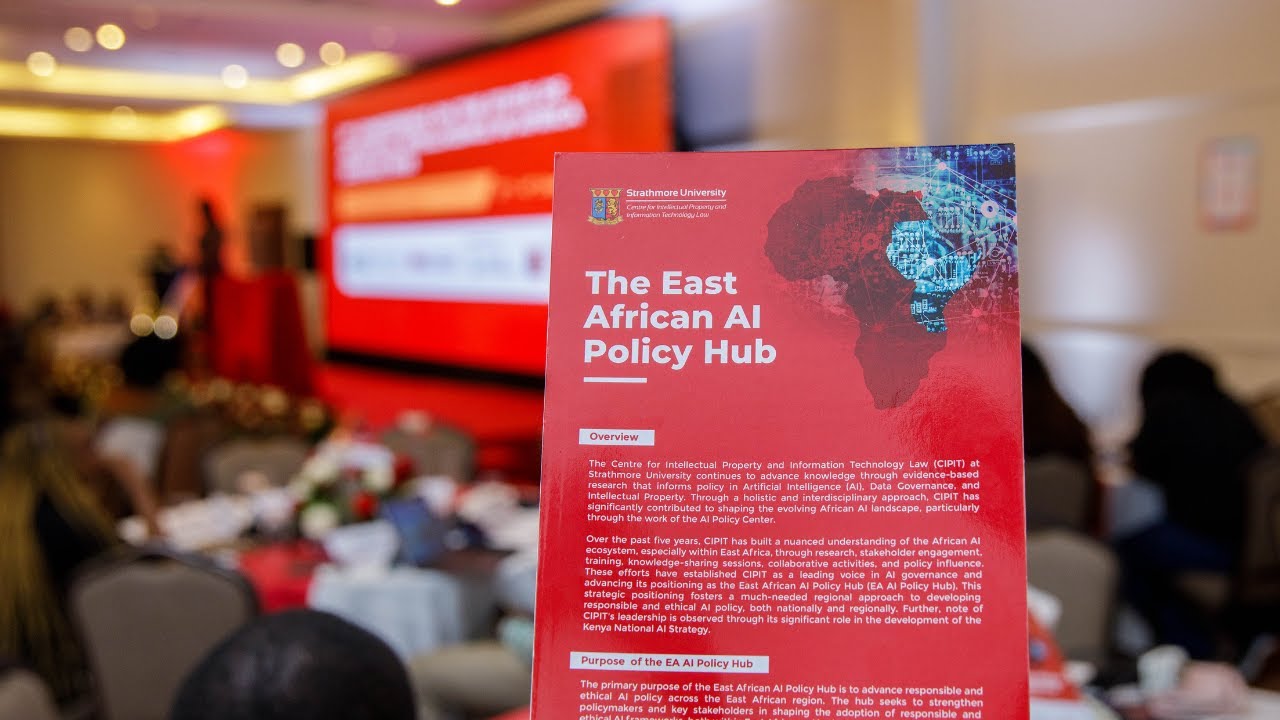
East African AI Policy Hub
The primary purpose of the East African AI Policy Hub is to advance responsible and ethical AI policy across the east african region
About
The Centre for Intellectual Property and Information Technology Law (CIPIT) at Strathmore University continues to advance knowledge through evidence-based research that informs policy and practice in Artificial Intelligence (AI), Data Governance, and Intellectual Property. Through its interdisciplinary and context-driven approach, CIPIT has played a significant role in shaping emerging AI governance conversations across Africa, particularly through the East African AI Policy Hub.
Over the years, CIPIT has developed an understanding of the African AI ecosystem, with a particular focus on East Africa, through research, policy engagement, institutional partnerships, training programmes, fellowships, and multi-stakeholder knowledge-sharing initiatives. These efforts have strengthened regional conversations on responsible and ethical AI governance while supporting the development of locally grounded approaches to AI policy and institutional adoption.
As the East African AI Policy Hub, CIPIT serves as a regional platform for advancing AI governance that is responsive to African realities, legal systems, and development priorities. The Hub works to strengthen institutional capacity, support evidence-based policymaking, foster cross-sector collaboration, and contribute to the development of governance frameworks that align innovation with constitutional values, human rights, accountability, and public interest considerations.
CIPIT’s leadership within the region is further reflected in its contribution to Kenya’s National AI Strategy process, as well as ongoing collaborations with public institutions, including the Kenyan Judiciary, to support context-specific and principle-based approaches to AI adoption and governance.
Watch the launch video
Purpose and Objective
The primary purpose of the East African AI Policy Hub is to advance responsible and ethical AI policy across the East African region. The hub seeks to strengthen policymakers and key stakeholders in shaping the adoption of responsible and ethical AI frameworks, both within East Africa and in the broader African context. The EA AI policy hub, envisioned as a collaborative vehicle, aims to focus on Kenya, Uganda, Rwanda, and Tanzania.
In advancing responsible and ethical AI policy, the East African AI Policy Hub aims to:
-
Act as a collaborative platform for knowledge sharing and policy dialogue, aiming at regional AI policy influence and discussions.
-
Advance and continue evidence-based knowledge production related to AI policy and governance.
-
Enhance and influence AI policy and governance to reflect holistic elements of responsible and ethical AI policy.
-
Present nuances through gendered perspectives and disability-sensitive work, creating an inclusive, participatory, and accountable AI ecosystem.
-
Achieve a more cohesive and integrated approach towards developing responsible and ethical AI policy and governance across East Africa.
Institutional Strengthening
AI Governance training and Capacity building with the Judiciary of Kenya
Through the East African AI Policy Hub, CIPIT has been collaborating with the Kenyan Judiciary to support the responsible and context-sensitive adoption of artificial intelligence within judicial processes. This collaboration has focused on the development of an AI Adoption Policy Framework that provides structured guidance on how AI systems may be introduced and governed within the justice sector in a manner aligned with Kenya’s constitutional principles, institutional realities, and broader public interest obligations.
The collaboration examines where AI systems may appropriately support judicial functions, including legal research, transcription, case management, and administrative efficiency, while also clearly defining the limits of AI use, particularly in relation to judicial reasoning, decision-making, and the protection of fundamental rights. Grounded in principles of due process, procedural fairness, judicial independence, accountability, and human oversight, the framework approaches AI adoption not merely as a technological advancement, but as a governance and institutional question requiring careful safeguards and clear responsibility structures.
Beyond policy development, the collaboration has also prioritised judicial capacity building through initiatives such as the Judicial AI Masterclass series and the Judicial AI Fellowship. These engagements are designed to strengthen AI literacy among judicial officers, deepen understanding of the opportunities and risks associated with AI systems, and support informed, contextually grounded approaches to AI governance within the Judiciary. Through this work, the Kenyan Judiciary is contributing to broader regional conversations on AI governance while positioning itself to responsibly oversee and engage with emerging technologies across society.
National Council on the Administration of Justice (NCAJ) committee training on AI Governance
CIPIT delivered a capacity-building workshop for the National Council on the Administration of Justice (NCAJ) ICT Committee on Harnessing Artificial Intelligence for Effective Administration of Justice. The training brought together representatives from key justice sector institutions to strengthen their understanding of AI, emerging AI governance frameworks, and the implications of Kenya’s proposed National AI Act for the justice sector. Through interactive discussions, participants explored the opportunities, risks, and safeguards associated with the responsible adoption of AI, reinforcing the capacity of justice sector institutions to advance accountable, transparent, and rights-based digital transformation.
Convenings
East African AI Policy forum
The first bi-annual forum themed “Regional Dialogue on Language Data Governance, Infrastructure, and Collaborative Policy in East Africa,” was held from 28–29 May 2026 in Kigali, Rwanda. Convened as a two-day regional dialogue, the forum brought together participants from Kenya, Tanzania, Uganda, and Rwanda, including government officials, academic researchers, legal practitioners, and technical experts.
The forum was intentionally designed as a space for East African stakeholders to engage in open and collaborative discussions on language data governance, AI infrastructure, and emerging AI policy priorities. Participants shared insights from their respective national contexts, exchanged experiences on governance approaches, and identified common challenges, opportunities, and areas for regional collaboration. The emphasis on peer learning and knowledge exchange fostered a shared understanding of the policy and institutional landscape shaping AI development across East Africa.
As part of the forum, CIPIT also presented its ongoing work on the East African AI Policy Outlook Report, a regional initiative that monitors and analyses AI policy developments across East Africa. The discussion provided an opportunity to gather stakeholder perspectives, validate emerging trends, and strengthen regional collaboration in support of evidence-based AI policymaking.
Fellowships
Artificial Intelligence (AI) Policy Fellowship: Foundations and Governance for Policy Makers
This Fellowship is an initiative of the EA AI Hub, designed to strengthen policy capacity on AI governance across the public sector. To date, the Fellowship has successfully equipped two cohorts of policymakers and regulators with the knowledge and tools required to engage with AI policy and governance challenges.
This fellowship is designed specifically for policymakers, regulators, and government officials involved in technology governance, public sector AI projects, or data policy frameworks.
Impact

AI Policy Fellowship Wrap Up Ceremony

Launch of AI Policy Fellowship | Cohort 1

Artificial Intelligence (AI) Policy Fellowship Wrap up Ceremony | Cohort 2
No results found matching your search criteria.
Stay Updated
Subscribe to our newsletter to receive the latest research, publications, and blog posts directly in your inbox.