
Research theme
IP And Innovation
We explore how intellectual property (IP) frameworks can spur innovation while safeguarding the interests of creators, businesses, and the public. Through research and specialized training on emerging technologies and evolving IP laws, we help shape policies that promote creativity, economic growth, and inclusive development.
- Intellectual Property and Innovation Research
- The Right to Research and Copyright Law: Text and Data Mining
- Intellectual Property and Artificial Intelligence
- Eastern Africa Hub for Open AIR
- The Nwulite Obodo Open Data License
- Research Outputs
Intellectual Property and Innovation Research
In an era of rapid technological advancement, the intersection of intellectual property (IP) and innovation plays a pivotal role in shaping economies and societies. Our Intellectual Property and Innovation research delves into the evolving landscape of IP laws, policies, and practices, with a particular focus on emerging technologies and industries.
Our research provides in-depth analysis and insights into how IP frameworks can support innovation while balancing the rights and interests of creators, businesses, and the public. We explore a wide range of issues, including patent law, copyright, trademarks, trade secrets, geographical indications, traditional knowledge, and traditional cultural expressions. We place a special emphasis on their impact on the digital technology, creative industries, and biotechnology sectors.
We provide evidence-based research and impartial analysis to support ongoing discussions on IP policy development at local, national, and continental levels. Our objective is to foster economic growth, safeguard creative and innovative endeavours, and ensure that IP policies are responsive to the challenges of an increasingly globalized and digital world.
The Right to Research and Copyright Law: Text and Data Mining
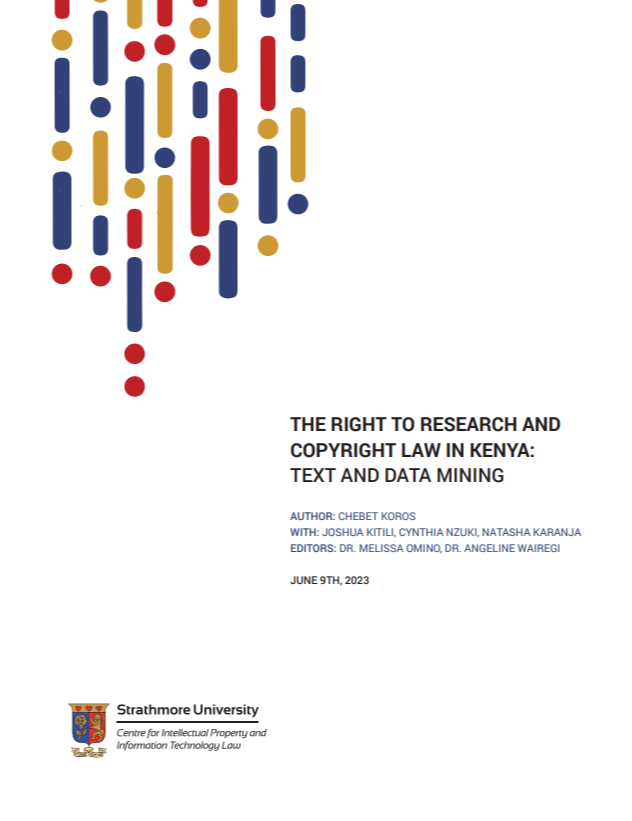
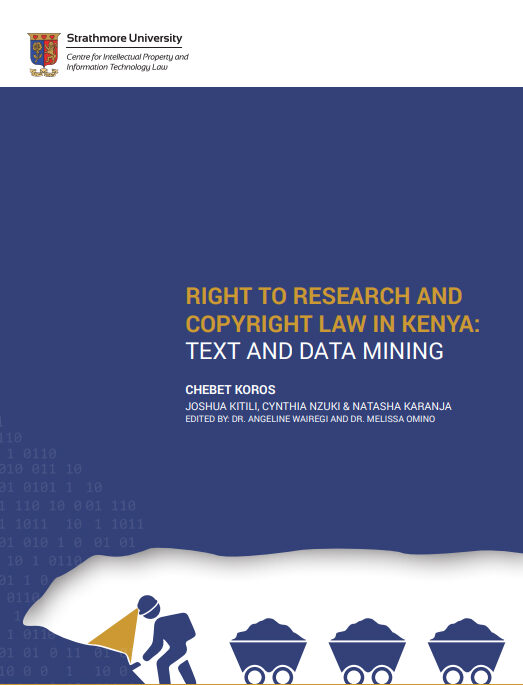
Text and Data Mining (TDM) technology is a valuable tool in research, enabling the analysis of large amounts of data quickly. TDM involves a four-step process of identifying relevant documents, converting them to machine-readable format, extracting structured data, and mining the data for new knowledge. However, conducting research using TDM in Kenya presents several challenges, such as the absence of a supportive legal framework, limited access to reliable internet connections, a shortage of AI experts, and insufficient financial resources. TDM research often involves the use of copyrighted materials, requiring either consent from the copyright owners or exceptions in copyright law. While some countries have amended their laws to provide specific exceptions for TDM, Kenya’s copyright law lacks clarity in this regard. Kenya’s copyright framework has an exception for scientific research, but there is a lack of clarity on whether TDM research falls under this exception. Comparisons with South Africa’s copyright amendment law highlight the need for more specific and flexible exceptions. This research found that Kenya’s copyright exceptions and limitations should be updated and expanded to accommodate TDM research and other technology-based research. International guidelines are also needed to address the application of copyright to TDM technology. Read more on our research findings and recommendations in this Policy Brief and White Paper.
Intellectual Property and Artificial Intelligence
The convergence of Artificial Intelligence (AI) and Intellectual Property (IP) rights marks a new era of innovation and creativity. AI’s advanced algorithms are swiftly reshaping industries, yet their integration presents a complex tapestry of challenges and unprecedented possibilities within the IP domain.
Booklets
The “IP and AI” booklet series is a concise guide to understanding Intellectual Property (IP) in the Artificial Intelligence (AI) landscape. Explore the intricate relationship between Intellectual Property (IP) and AI as we provide essential insights and real-world case studies. Whether you are a tech entrepreneur, a legal expert, or simply curious about technology and IP, these booklets serve as your roadmap to grasp how IP intersects with AI innovations in the digital age.
Articles
In the realm of patents, AI-generated innovations challenge traditional notions of inventorship, raising questions about novelty and inventiveness. The case of DABUS, an AI system that sought patents without human intervention exemplifies this complexity. Different jurisdictions have a varied stance on this, with the US and EU rejecting AI as inventors, and Australia initially accepting it before reversing its decision. On the other hand, South Africa granted a patent to DABUS. Notably, Kenya’s law maintains a human inventorship requirement. Read more on this here.
In the domain of trademarks, AI revolutionizes administration by enhancing evaluation and registration processes through image recognition and classification. However, as AI influences consumer experiences, particularly in tailored recommendations, its role in trademark law becomes more complex. AI’s impact on consumer decisions complicates infringement cases, challenging established confusion standards. Read more on this here.
In copyright, AI’s creative potential intersects with existing laws. Different jurisdictions diverge on whether AI can be an author, with Europe emphasizing the requirement for the “author’s own intellectual creation,” the US, Australia, and Kenya requiring human authorship, and the UK uniquely protecting AI-created works. Read more on this here.
AI components find protection in trade secrets, which safeguard algorithms and know-how. The advantages of trade secrets over patents include immediate protection and lenient requirements. However, proving infringement in trade secrets is challenging. Read more on this here.
Navigating the fusion of AI and IP demands precise legal frameworks and ethical guidelines. Collaborative efforts among policymakers, legal experts, and stakeholders are also crucial to balancing innovation, rights, and ethics as AI reshapes industries.
Read more about the practical impact of AI on IP here and here.
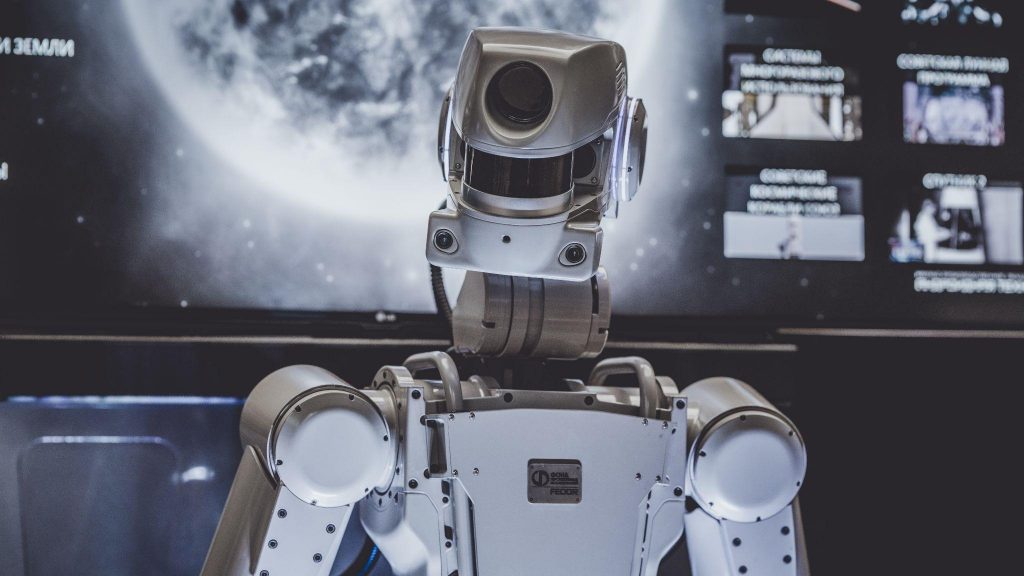
The Copyright Conundrum: AI-Generated Works and the Question of Authorship

Intellectual Property & Artificial Intelligence: Chat GPT – A Battle Against Plagiarism in the Realm of Academic Essays

INTELLECTUAL PROPERTY AND ARTIFICIAL INTELLIGENCE: CAN TRADE SECRETS PROTECT AI?

INTELLECTUAL PROPERTY & ARTIFICIAL INTELLIGENCE: TRADEMARK ADMINISTRATION AND INFRINGEMENT
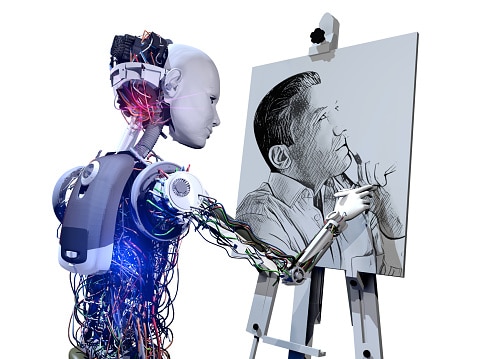
INTELLECTUAL PROPERTY AND ARTIFICIAL INTELLIGENCE: CAN ARTIFICIAL INTELLIGENCE RECEIVE COPYRIGHT PROTECTION?

INTELLECTUAL PROPERTY & ARTIFICIAL INTELLIGENCE: A LOOK INTO AI AND PATENT INVENTORSHIP AND OWNERSHIP
Eastern Africa Hub for Open AIR
CIPIT proudly serves as the Eastern Africa institutional hub for Open AIR (African Innovation Research), a pan-African network focused on uncovering new insights about the balance between control over and access to knowledge. Open AIR addresses a fundamental challenge in intellectual property (IP) and innovation policy: reconciling the tensions between control and access, exclusivity and sharing, as well as competition and collaboration. The network’s African-centered research highlights the importance of context in shaping sustainable IP policies that ensure the benefits of innovation are shared equitably across society.
As the regional hub, CIPIT leads efforts to research IP systems that foster open and inclusive innovation, train stakeholders to effectively apply new insights in knowledge governance, and investigate high-impact themes such as high-tech hubs, informal sector entrepreneurship, and indigenous knowledge systems.
CIPIT also plays a key role in advancing Open AIR’s vision of positioning Africa at the forefront of the global knowledge economy. By fostering sustainable partnerships with institutions and experts from Africa, Canada, and beyond, CIPIT connects emerging African researchers with global counterparts. These collaborations amplify African perspectives, ensuring that groundbreaking research from the continent shapes global innovation policies.
Through its leadership as Open AIR’s Eastern Africa hub, CIPIT is driving innovation, inclusivity, and sustainable development, while showcasing Africa’s crucial contributions to the global knowledge economy.
The Nwulite Obodo Open Data License: An Equitable Way to Share African Datasets
The Nwulite Obodo Open Data License (NOODL) is a groundbreaking framework designed to promote equitable data sharing across Africa and other developing nations. Unlike standard open licenses, which apply uniform rules to all users, the Nwulite License acknowledges the unique contexts of African dataset creators and ensures that local communities benefit from the use of their data.
The drafting and development process has been a collaborative effort between researchers at Data Science Law Lab, Data Science for Social Impact, Centre for Intellectual Property and Information Technology Law and numerous members of the African dataset community who are committed to open, equitable licenses for sharing African datasets. The license was launched at the Empowering African Voices in AI: Data, Models, and Innovation workshop co-hosted by CIPIT and Data Science Law Lab, which took place on September 6, 2024 at the Deep Learning Indaba 2024 in Dakar, Senegal.
Why a New License?
Traditional open licenses, such as Creative Commons and Open Data Commons, do not account for the realities of African data sharing. They often:
-
Overlook community contributions, making proper attribution difficult.
-
Fail to prevent exploitative practices, such as digital colonialism and data extraction.
-
Impose one-size-fits-all terms, disregarding local governance and cultural knowledge systems.
How the Nwulite License Works
The license distinguishes between users from developing countries and users from outside these regions, ensuring that data sharing remains fair and transparent:
-
Developing country users: can use, modify, and share datasets freely but must re-share under the same license and keep data within developing nations.
-
Users outside developing countries: must provide royalties or benefits to African dataset creators when using or modifying the data.
-
All users: must attribute contributors, avoid imposing additional restrictions, and respect the rights of local communities.
Additional Tools: The African Dataset Creation Split Sheet
To further support transparent and fair data governance, the Nwulite License includes a customizable tool that helps contributors document their input and agree on data ownership before sharing begins.
Research Outputs
The Copyright Conundrum: AI-Generated Works and the Question of Authorship
Intellectual Property & Artificial Intelligence: Chat GPT – A Battle Against Plagiarism in the Realm of Academic Essays
INTELLECTUAL PROPERTY AND ARTIFICIAL INTELLIGENCE: CAN TRADE SECRETS PROTECT AI?
INTELLECTUAL PROPERTY & ARTIFICIAL INTELLIGENCE: TRADEMARK ADMINISTRATION AND INFRINGEMENT
INTELLECTUAL PROPERTY AND ARTIFICIAL INTELLIGENCE: CAN ARTIFICIAL INTELLIGENCE RECEIVE COPYRIGHT PROTECTION?
INTELLECTUAL PROPERTY & ARTIFICIAL INTELLIGENCE: A LOOK INTO AI AND PATENT INVENTORSHIP AND OWNERSHIP
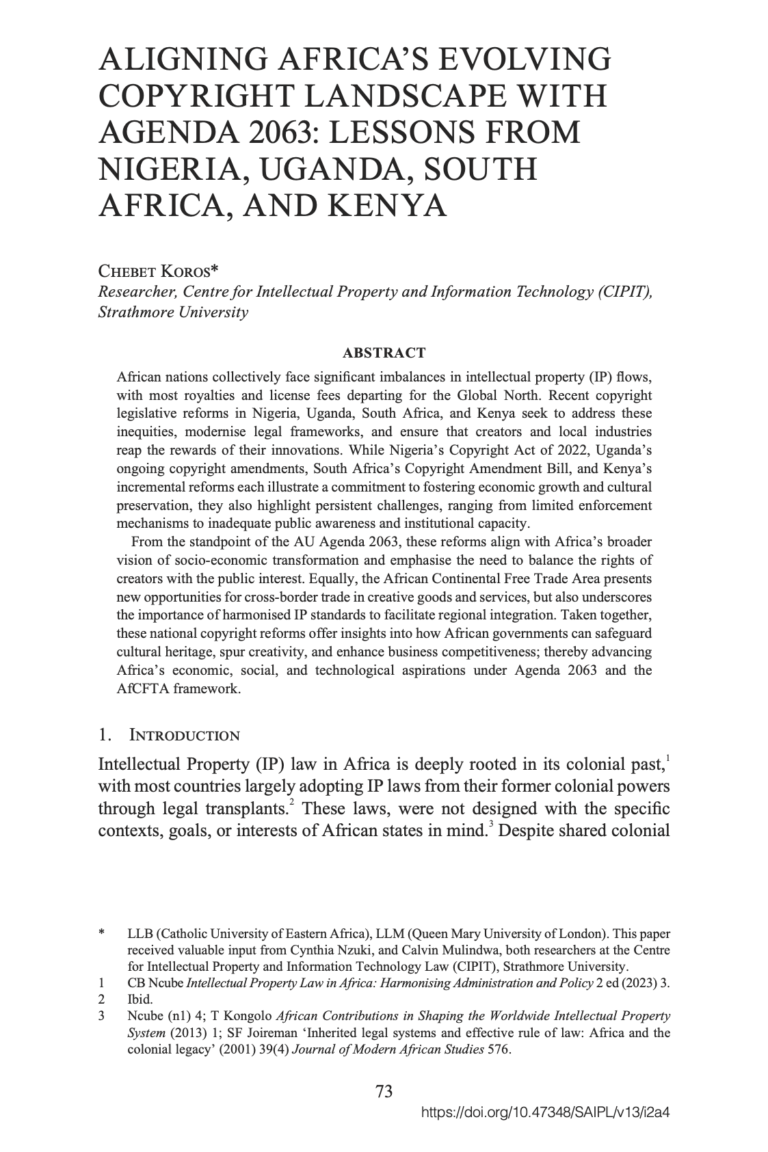
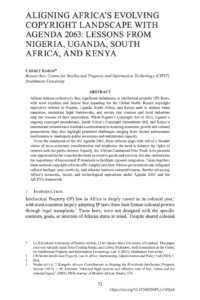
Aligning Africa’s evolving copyright landscape with Agenda 2063: Lessons from Nigeria, Uganda, South Africa, and Kenya

A critical review of intellectual property rights in the Kenyan tea sector
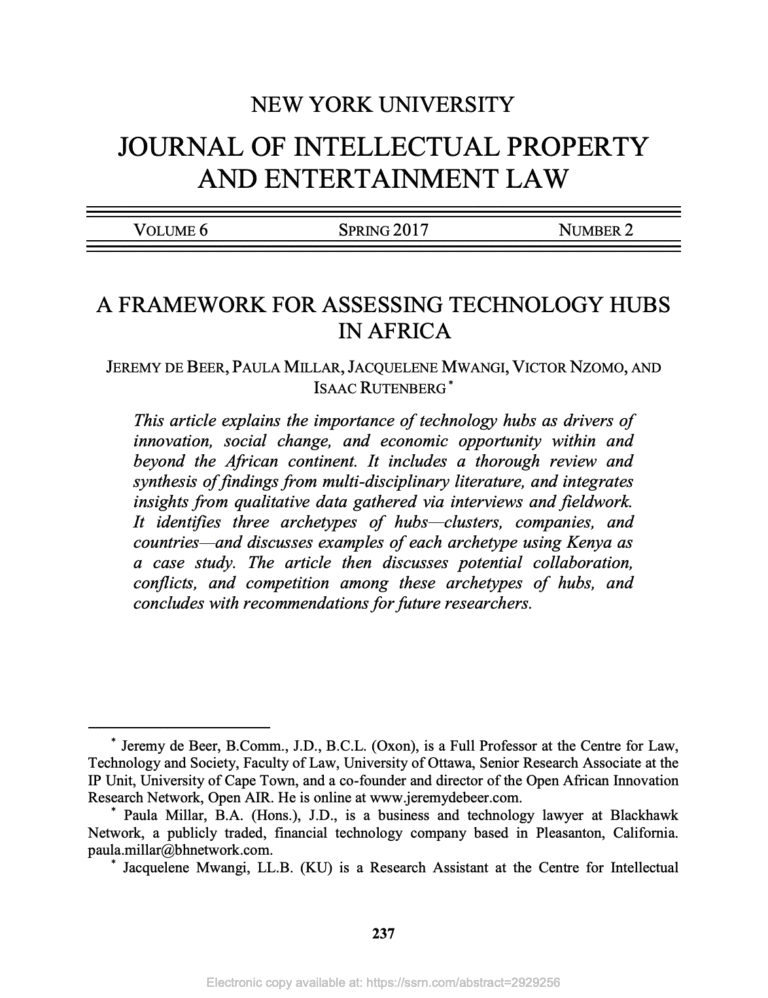
Framework for assessing technology hubs in Africa
Utility model protection in Kenya: The case for substantive examination

Do patents and utility model certificates encourage innovation in Kenya?
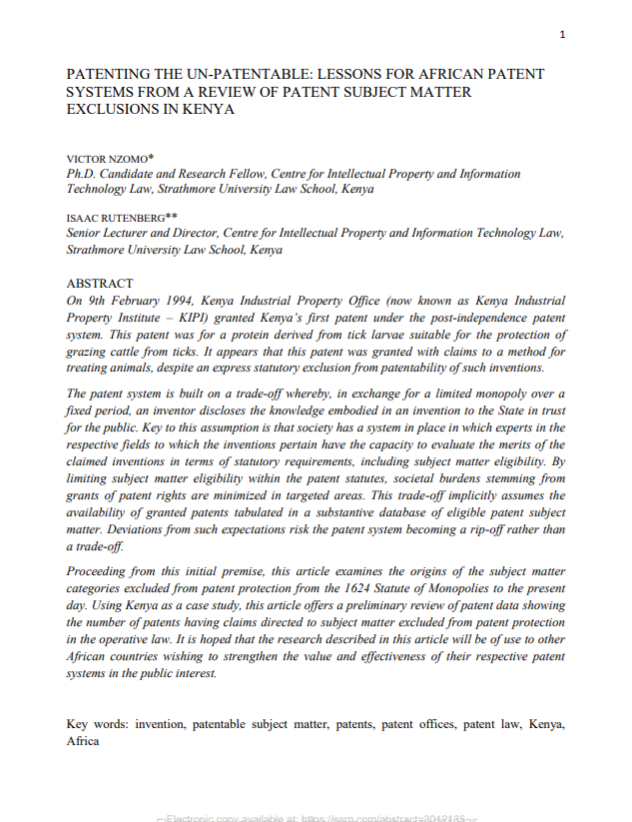
Patenting the un-patentable: Lessons for African patent systems from a review of patent subject matter exclusions in Kenya.



ICT Policy Africa
A global initiative that seeks to map and analyse the evolution and impacts of legal frameworks in digital environments by aggregating, organizing, and visualizing distributed legal data through open research methodologies, data models, taxonomies, and databases.
Open database (opens in a new tab)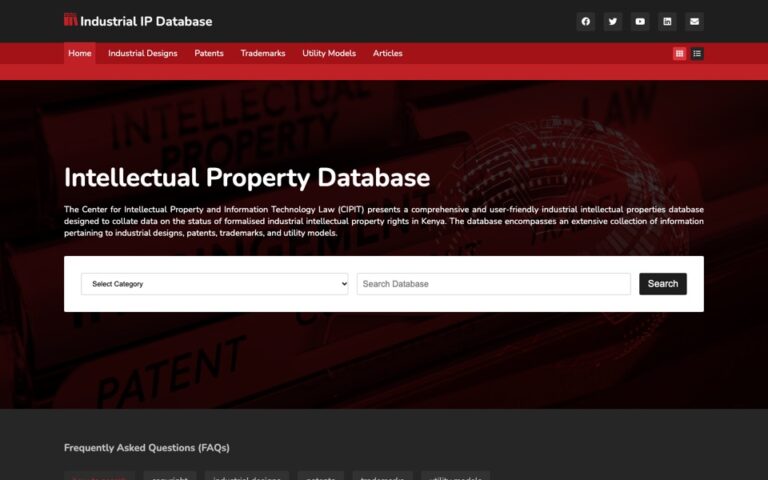
Industrial Intellectual Properties Database (Kenya)
A comprehensive and user-friendly database designed to collate data on the status of formalised industrial intellectual property rights in Kenya. The database encompasses an extensive collection of information pertaining to industrial designs, patents, trademarks, and utility models.
Industrial designs·Patents·Trademarks·Utility models
Open database (opens in a new tab)IP Case Law Library (Kenyan Courts)
A comprehensive repository of intellectual property rulings and judgments from Kenyan courts, providing expertly curated case briefs, offering clear and concise summaries of legal decisions in various areas of intellectual property law, including patents, trademarks, copyright, industrial designs, and more.
Open database (opens in a new tab)No results found matching your search criteria.
IP & Innovation publications
Reports, briefs and articles from our IP & Innovation work.