

Introduction
On 30 June 2026, President William Ruto chaired a Cabinet meeting at State House, Nairobi, in which the Cabinet established a Standing Cabinet Committee on Artificial Intelligence (the Committee).1 This Committee was formed with the mandate of steering Kenya’s national artificial intelligence (AI) strategy, coordinating policy across government, and positioning Kenya as a regional leader in responsible AI development and adoption. The Committee has been tasked with advancing innovation, productivity, public service delivery, job creation and inclusive economic growth driven by AI, while also putting in place appropriate governance frameworks and safeguards.2 The move builds on the National AI Strategy 2025-2030, which was launched in March 2025 by the Ministry of Information, Communications and the Digital Economy (MICDE).3 This piece situates the Committee within the architecture of the Strategy and other legal instruments and assesses its impact on the landscape of AI governance in Kenya.
Kenya’s National AI Strategy 2025-2030
Kenya’s National Artificial Intelligence Strategy 2025–2030 (the Strategy) aims to position the country as an AI innovation hub, emphasising ethical AI, digital infrastructure and inclusive growth.4 It recognises that the journey towards becoming a leader in AI development and adoption involves fostering innovation, but also ensuring responsible use of AI.5 It therefore advocates for harnessing AI as a tool for national development and social progress, while guarding against potential misuse and unintended negative consequences.6
Three key pillars anchor the Strategy, the first is AI digital infrastructure, referring to the need for accessible and affordable AI infrastructure and a modernised national digital infrastructure to enable AI access and development. The second is data, which aims to establish a robust and sustainable data ecosystem for AI and innovation. The third pillar is AI research and innovation, which emphasises the drive to develop localised AI models and solutions through local research and development, innovation and commercialisation. These are supported by four enablers: governance, which involves the establishment of a legal and regulatory framework; talent development, involving promotion of AI literacy and education; investment, from public and private sources; and AI development and deployment, which is equitable, ethical and inclusive.7 Each of these seven aspects set out in the strategy forms the basis of flagship projects outlined for the Strategy’s implementation.8
With regards to governance, the Strategy sets out key action points for the development of Kenya’s AI regulatory framework, including: developing an AI and emerging technologies policy that aligns with the Strategy; proactively implementing a soft regulatory framework for AI; developing an AI and Other Emerging Technologies Act and regulations as AI matures in Kenya; and developing a flexible regulatory environment using sandboxes to inform development of a regulatory framework and standards.9 The implications of these projects, as well as other flagship projects within the Strategy, are that AI governance in Kenya requires institutional coordination to ensure the seamless formulation and implementation of a regulatory structure aligned with the country’s broader vision for AI. This is further reflected in the Strategy’s own limitation assessment, which points to fragmentation and uncoordinated prioritisation of development and application of AI as a concern in Kenya’s AI readiness.10 The Committee’s formation seems to be a positive step in this direction, with its remit including directing the AI agenda and coordinating policy across the different ministries that are involved and affected.11 As such, the establishment of the Committee marks an important step towards translating the Strategy’s commitments into practice, with the Strategy being a foundational anchor for the recently published Draft National Policy on Artificial Intelligence and Emerging Technologies and the broader institutional, legal and policy building blocks required to support a robust AI governance ecosystem in Kenya.
Progress in AI governance approaches and implications for the Kenyan AI Ecosystem.
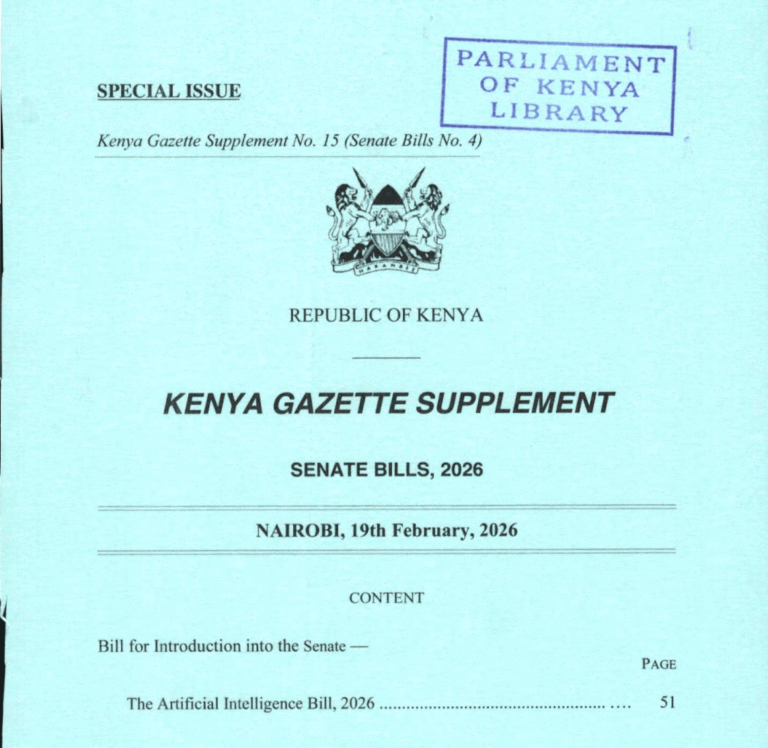
Since the adoption of the Strategy, Kenya has made progress towards developing its AI governance ecosystem through a combination of strategic, policy, legislative and institutional measures. Whereas the Strategy provides the overarching direction, the recently published Draft Kenya AI and other Emerging Technologies Policy 2026, the Draft National Data Governance Policy 2026, the Artificial Intelligence Bill 2026 and existing sectoral laws and standards represent interconnected building blocks through which its commitments may be translated into practice.
These measures indicate a gradual movement from broad strategic ambition towards a more operational governance architecture addressing institutional coordination, data governance, risk management, accountability and sector-specific implementation. The establishment of the Committee serves as a governance mechanism to implement the Strategy’s goals by coordinating policy across relevant governmental departments. However, it does not exist in a silo; it comes into a pre-existing ecosystem of regulatory instruments that are either already in place or being designed and implemented.
The publication of the Draft AI and other Emerging Technologies Policy is particularly significant because it advances the policy instrument contemplated by the Strategy and places coordination at the centre of implementation. It proposes a hybrid governance model that combines central strategic oversight with distributed implementation across ministries, regulators, county governments, the private sector, academia, and civil society. Its proposed architecture includes a National AI and other Emerging Technologies Steering Committee, a statutory Council, a MICDE Secretariat, technical working groups and sectoral and county-level actors. This approach recognises that AI governance cannot be delivered through a single institution, instead, it depends on clearly differentiated mandates, effective information-sharing and the alignment of national priorities with sectoral expertise and regulatory authority.
The Draft National Data Governance Policy and the AI Bill also form part of the same developing architecture. The former addresses the data foundations required for AI development and cautions against fragmented standalone laws that are not anchored in a coherent umbrella framework.12 The latter seeks to move AI governance into a binding legislative framework. The development of these instruments alongside the Draft AI Policy demonstrates policy momentum, but also raises questions of alignment. As the instruments are being developed in tandem, there is a continuous need to ensure that the eventual legal framework is informed by the policy process, aligned with data governance and existing sectoral mandates, and responsive to evidence generated through implementation.
Against this backdrop, the Standing Cabinet Committee’s significance lies in its potential to provide the high-level political and inter-ministerial coordination needed to hold these building blocks together. Its implementation mandate can support the prioritisation of the Strategy’s flagship projects, resolve cross-government mandate and resource questions, and promote coherence between the Strategy, the Draft AI Policy, the Data Governance Policy, legislative proposals and sectoral initiatives. The Committee’s contribution to Kenya’s AI ecosystem will therefore depend on its operationalisation as a coordinating and implementation mechanism that connects Cabinet-level direction with technical, regulatory and sectoral delivery, while monitoring progress against the Strategy’s 2025–2030 timeframe.
Conclusion
In conclusion, the Committee’s formation represents an important step in implementing the Strategy’s ambitious goals for AI in Kenya by coordinating government departments and regulatory bodies to deliver the outlined projects that aim to continuously build and shape the Kenyan AI Ecosystem.
Image used is from envato
List of references
Agatha Gichana, ‘A deep-dive of the Draft Data Governance Policy’ (Vellum Kenya, 5 June 2026) <https://vellum.co.ke/a-deep-dive-of-the-draft-data-governance-policy-2026/>.
Ariana Issaias, Mumbi Kiragu and Sahara Ali, ‘Kenya: Artificial Intelligence Bill, 2026 – Proposed too soon?’ (Bowmans Law, 23 April 2026) <https://bowmanslaw.com/insights/kenya>.
Artificial Intelligence Bill 2026 (Kenya).
Carrington Malin, ‘Kenya Cabinet forms committee to drive national AI strategy’ (Africa AI News, 2 July 2026) <https://www.africaainews.com/p/kenya-cabinet-forms-committee-to>.
David Indeje, ‘Inside Kenya’s AI Policy: Governance, regulation and the future of innovation’ (KICTANet, 16 February 2026) <https://www.kictanet.or.ke/inside-kenyas-ai-policy->.
David Indeje, ‘Kenya’s AI & Emerging Technologies Policy: Government Perspectives’ (KICTANet, 12 February 2026) <https://www.kictanet.or.ke/kenyas-ai-emerging-technologies->.
Ernst & Young LLP, ‘Kenya releases the National AI Strategy 2025-2030’ (EY News, 30 October 2025) <https://globaltaxnews.ey.com/news/2025-2193-kenya-releases-the-national-ai>.
<https://regulations.ai/regulations/RAI-KE-NA-KNAISXX-2025>.
Lawyard, ‘Kenya elevates AI governance with cabinet committee, bolsters BPO sector with new policy’ (4 July 2026) <https://www.lawyard.org/news/kenya-elevates-ai-governance-with->.
Liz Orembo, ‘What Kenya’s AI Bill gets wrong about political expression’ (Tech Policy Press, 22 May 2026) <https://www.techpolicy.press/what-kenyas-ai-bill-gets-wrong-about-political->.
Parliament of Kenya, Bill Digest: The Artificial Intelligence Bill 2026 <https://www.parliament.go.ke/sites/default/files/2026-04/Bill%20Digest%20-%20The%20Artificial%20Intelligence%20Bill%2C%20No.4%20of%202026.pdf>.
Raylenne Kambua, ‘Outpaced by its own ambition: Can Kenya bridge its AI regulation gap?’ (CIPESA Blog, 11 May 2026) <https://cipesa.org/2026/05/can-kenya-close-the-gap-between->.
Republic of Kenya, Cabinet News of June 30, 2026, at State House, Nairobi.
Republic of Kenya, Draft Final National Data Governance Policy, May 2026.
Republic of Kenya, Kenya Artificial Intelligence Strategy 2025-2030 (March 2025) <https://ict.go.ke/sites/default/files/2025-03/Kenya%20AI%20Strategy%202025%20-%20203>.
Republic of Kenya, The Kenya National Digital Masterplan 2022-2032.
Tasneem Ahmed, ‘AI Policy Corner: The Kenya National AI Strategy’ (Montreal AI Ethics Institute, 22 June 2025) <https://montrealethics.ai/ai-policy-corner-the-kenya-national-ai->.
UNESCO, ‘Kenya Artificial Intelligence Readiness Assessment Report’ (2025) <https://unesdoc.unesco.org/ark:/48223/pf0000392693>.
1 Republic of Kenya, Cabinet News of June 30, 2026 at State House, Nairobi.
2 Ibid.
3 Carrington Malin, ‘Kenya Cabinet forms committee to drive national AI strategy’ (Africa AI News, 2 July 2026) <https://www.africaainews.com/p/kenya-cabinet-forms-committee-to>.
4 Republic of Kenya, Kenya Artificial Intelligence Strategy 2025-2030, (March 2025), Executive summary <https://ict.go.ke/sites/default/files/2025-03/Kenya%20AI%20Strategy%202025%20-%20203>.
5 Ibid, 19.
6 Ibid.
7 Ibid, Executive summary, 67.
8 Ibid, 69-82.
9 Ibid, 78-79.
10 Ibid, 57.
11 Republic of Kenya, Cabinet News of June 30, 2026
12Ministry of Information, Communications and the Digital Economy, Draft Final National Data Governance Policy (2026) https://ict.go.ke/sites/default/files/2026-05/Draft%20Final%20National%20Data%20Governance%20Policy%20May%2025%202026.pdf


Comments